As a Project Manager onboarding to a new project is equal parts exciting and terrifying. In an ideal world, a perfect handover or a detailed, well-structured onboarding is waiting for you. In the real world, this is rarely the case. Imagine someone hands you a puzzle. On the box you see a nice picture but when you open it, thousands of loose pieces are waiting to be put together. That is what stepping into a new project often feels like. Here is how to put it together without losing your mind in the first weeks.
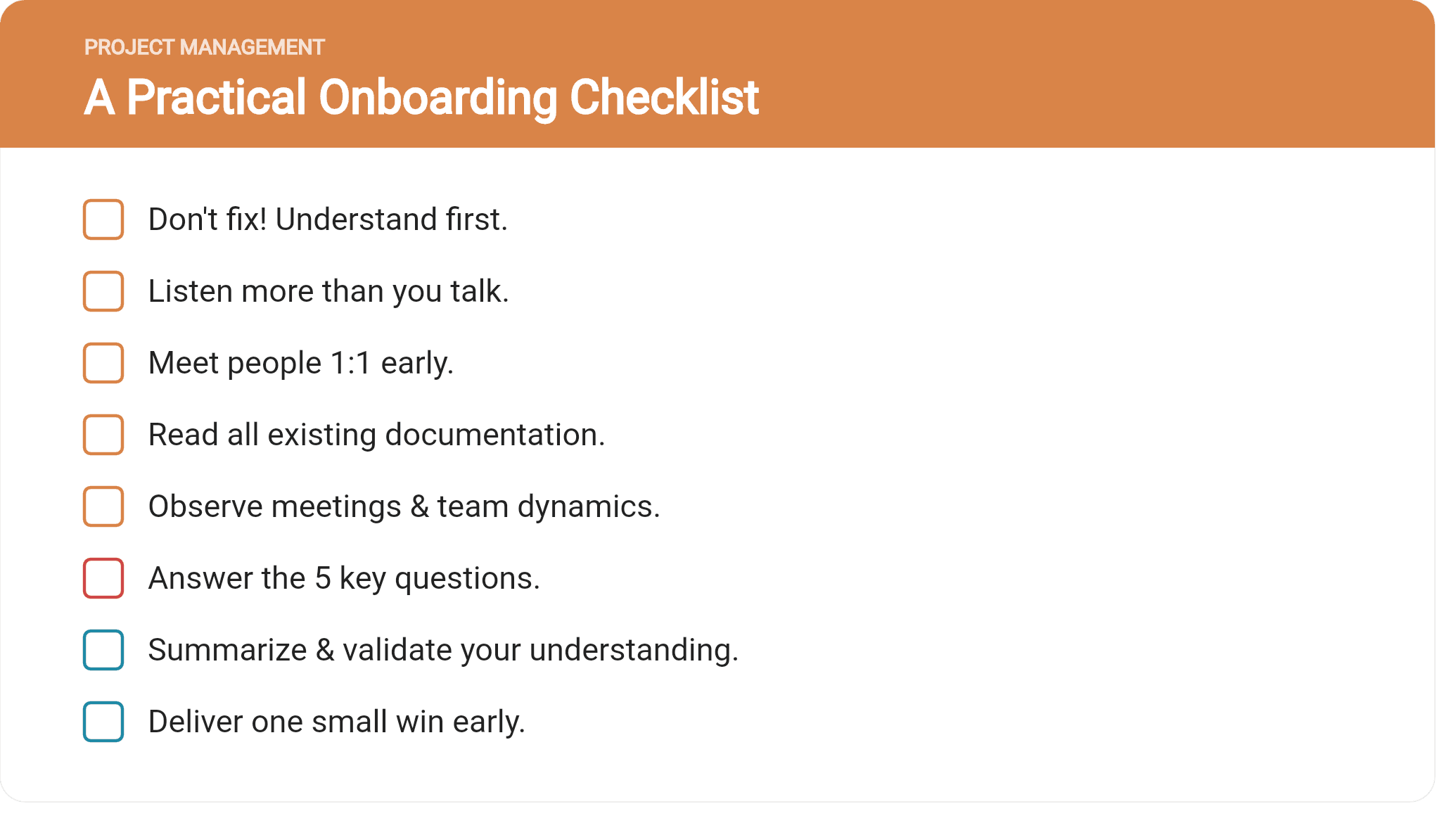
Don’t fix! Understand first.
Walking into a new project often comes with the urge to prove yourself immediately. Spotting things that look broken comes easily when entering with a fresh eye. And it is often the obvious things like a project plan that has not been updated in weeks, a meeting missing structure and without a clear outcome or a Confluence page that was last updated when the project kicked off. And every instinct tells you to fix it. Don't.
The things that look broken from the outside often have a history or a reason you don't know about. They might have been previous attempts to change something or the team is aware and just did not yet have a chance to get started on improvements. The fastest way to lose trust in the first weeks is to walk in with solutions to problems you don't fully understand. At this point your job isn't to improve the project. It's to understand it.
Listen more than you talk
The first weeks are not about output. They are about orientation. And the most important thing you can do is get close to two things at the same time: the people and the project itself.
The people:
Who is carrying the most context? Who has been on this project the longest? Who is quietly frustrated and why? A lot of what you need to know will never be written down anywhere and also not told via an org-chart. It lives in the heads of the involved people. And the only way to get it is to ask and listen. One-on-ones in the first weeks are not a formality, they are the most valuable source of information. Understanding the roles, the team dynamics, the main pain points and being able to read between the lines are essentials for a successful onboarding.
The project:
It´s not necessary to understand every technical detail you hear in the initial meetings. What is a must is a working picture of where things stand:
- Read all the documentation you can get, even the outdated parts since those can provide usefull insights on the history of the project.
- Sit in on as many meetings as possible.
- Watch how the team works together before you start influencing how they work.
Five questions to ask
The first weeks are challenging. The amount of new information can be overwhelming and initially seem chaotic. It is hard to connect any dots and the list of questions keeps growing while answers are rare. You won't have all the answers on day one. But you can ask the right questions.
1. What´s the true status of the project?
Documentation is almost always behind reality. The best way to get the honest picture is to talk to the people doing the work and ask them plainly: what is actually blocked, what is actually at risk, and what are you not saying out loud in the weekly calls?
2. What is the biggest risk nobody is talking about?
Figuring out early on the hidden risky aspect of the project is a gamechanger. Simpel things like a deadline everyone knows is unrealistic, a lack of data and analytics due to missing priorities or unclear responsibilities are classic examples. Being aware of these challenges allows to make on point decisions and to get a strong start on the project.
3. What has already been tried and why didn't it work?
This one will save you from your own enthusiasm. Walking into a new project with fresh energy is a good thing. Walking in and confidently suggesting something the team already tried and abandoned is not. Ask this question with genuine curiosity. The answers will tell a lot about the team's history, their dynamics, their opennes for change or about friction and conflicts.
4. Who can make things happen, and who can make things stop?
Pay attention to who people defer to in meetings, whose opinion influences the conversation, and whose silence signals disapproval. Figure out who has the power to slow things down or block progress entirely. Identify the stakeholder who can be a strong ally to the team and support progress.
5. What does the team need from me that they are not getting right now?
This is a scary question that earns the most respect when being asked. Every team has something they have been missing: clearer priorities, better communication, someone to shield them from constant scope changes, or simply a person who follows through on what they say they will do. Asking this question directly and early signals that you are there to make the team's work easier. And the answers will tell you where to focus your energy in the first weeks.
Connect with the team early
Every project has the people who just know how things really work. Connect with these people early not just to gather information, but because real trust is the foundation everything else is built on. Each team member carries knowledge and context that no document can provide. No process, no tool, and no framework will save a project where the PM and the team are not genuinely in sync.
A strong connection with the team is essential to become a respected part of it. They are the people who will give you an honest answer when you ask a hard question, flag something before it becomes your problem, and share crucial details upfront with you. In a new environment that kind of support network is worth more than anything else. The better connected you are with the team the more promising the collaboration will be.
Summarize & validate your understanding
When the observation phase is over, the next big step is making sense of everything you heard. By now you have enough context to start forming a real picture of where the project is healthy, where it is fragile, and where immediate actions might be needed.
A short summary or visualisation of your understanding of the project, the current state, the key risks, and the open questions sounds like a standard part of onboarding. Sharing that summary with someone on the project is the advanced approach and can be immensely useful. It shows that you have been paying attention, and it gives others the chance to correct possible misunderstandings. And it often naturally leads to more insightful conversations. Share the draft version of your thinking and let the team sharpen it.
Deliver one small win early
When the picture becomes clearer and the connection with the team starts to build, it´s time to pick something up. It does not have to be big. In fact, it is better if it is not. It can be a simple task or a small optimization.
This matters for two reasons. First, it signals to the team that you are here to carry weight, not just ask questions. Second, it gives you something concrete to learn from because owning even a small thing in a new environment will teach you more about how the project and the team works than another week of observation.
Pick your moment, take something off someone else's plate, and deliver it cleanly. That is how trust starts.
From catching up to keeping up
You will not have all the answers in the beginning, and you should not pretend to. But if you have done the work, something should have shifted from feeling like an outsider trying to catch up, to feeling like someone who belongs in the room.
Understand the project well enough to have an opinion, the team well enough to have their trust, and the stakeholders well enough to have a meaningful conversation. You should have one thing you own, five questions with honest answers, and a short list of risks you are already keeping an eye on.
It is not about getting all the details right from day one. It is about being an attentive observer and uncovering the information that is hidden beneath the surface.