Artificial intelligence is reshaping quality assurance by automating repetitive tasks and helping teams deliver software faster than ever before. While some people worry that AI will take over QA jobs, I see it as a powerful partner that enhances our productivity and efficiency. The real question is whether AI should be seen as a rival or a partner, and why human creativity remains irreplaceable in the testing process. The future of QA isn't about robots replacing us, it’s about humans and AI working together.
Introduction
Quality assurance has always been a super important part of building software. Honestly, without a solid way to test things, launching a stable product that users actually love is almost impossible. In the past, QA teams spent endless hours clicking through paths, digging into log files, and making sure a new feature didn't accidentally break old code. This old-school way worked fine when updates happened a few times a year, but it just can’t keep up with how fast we need to ship code today.
Now, with AI coming into play, everything is shifting. AI tools can now write test cases on the fly, spot weird bugs in logs, and even guess where code might break before the developers even finish building it. This quick change has a lot of tech people asking a big question: is AI here to help us do our jobs better, or is it trying to take them over completely?
How AI is moving into QA
We can already see AI becoming part of our daily QA routines. It can help with repetitive tasks, generate test ideas, and support testers during different stages of the testing process. For teams working with test automation, AI can also assist with creating and maintaining automated tests, reducing some of the effort needed to keep them up to date as applications evolve.
At the same time, AI tools can analyze historical defects and testing data to highlight areas of the application that may require more attention. This helps teams prioritize their efforts and focus testing where it matters most. By handling some of the more repetitive activities, AI gives testers more time to concentrate on exploratory testing, critical thinking, and understanding the user experience.
My experience: Using AI for better test coverage
Personally, I’ve started using AI regularly in my daily workflow, and it has become a useful addition to my QA toolkit. As a QA, I often use it to brainstorm test scenarios, think through edge cases, and challenge my assumptions about how users might interact with a feature.
When working on new functionality, I sometimes provide the requirements or user stories and ask AI to suggest additional test cases or alternative user flows that I may have overlooked. It doesn’t replace critical thinking or domain knowledge, but it can be helpful for broadening the testing perspective and improving coverage.
It has also been valuable when working with test automation. Rather than writing tests for me, AI has helped with tasks such as setting up integrations, configuring test environments, or finding solutions for more complex automation scenarios that would otherwise require additional research and experimentation.
Partnership vs rivalry: What’s the real story?
The debate about AI in testing usually splits people into two camps. On one side, companies that just want to cut costs and speed things up look at AI as a way to automate literally everything. This makes it feel like a rivalry, putting human testers against machine intelligence. But honestly, that view usually comes from people who don’t really understand what true quality assurance takes.
On the other side, QA professionals know that testing isn't just about getting a green "pass" or a red "fail" mark. True validation needs human judgment, context, and quick decision-making. QA is way more than just running a script, you need to understand the business goals and what the user actually experiences. So, looking at AI as an enemy misses the point entirely. The real value comes when we treat it as a supportive partner.
The real shift isn't AI replacing QA engineers., it's QA engineers who know how to use AI outperforming those who don't.
Why human creativity still wins
AI is incredibly good at recognizing patterns, crunching log data, and running massive test matrices. But it completely falls short when it comes to real human creativity, empathy, and intuition. An app can pass every single automated script perfectly and still be confusing, ugly, or frustrating for a real customer to use.
This is where human testers shine. We can explore the app unpredictably, think like a frustrated user, and break workflows on purpose to find hidden issues. This kind of exploratory testing comes from pure curiosity and knowing the product inside out. It uncovers those tricky, multi-layered bugs that predefined scripts and AI templates will always miss.
What the future looks like
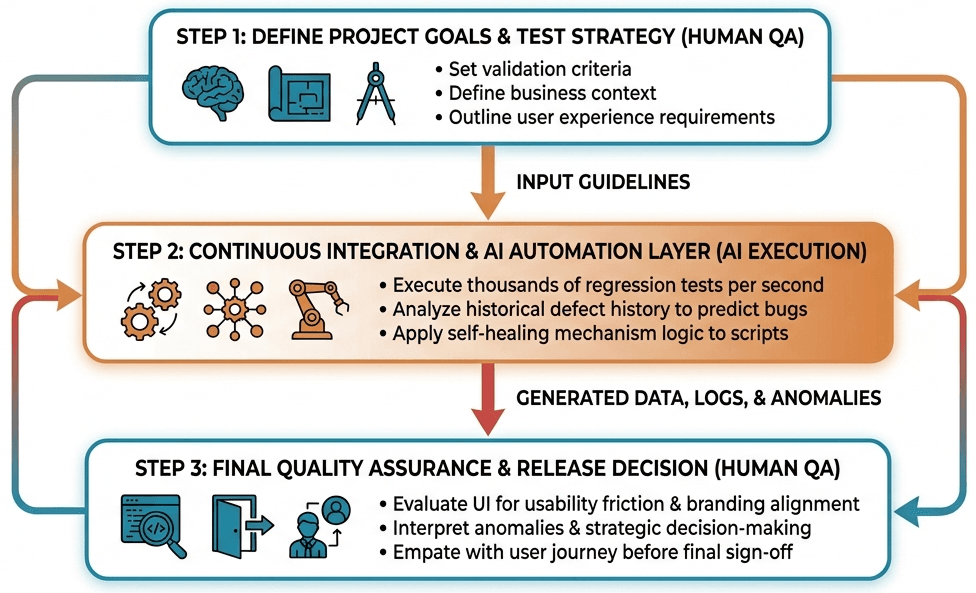
The future of software testing is definitely a hybrid model. Instead of replacing, AI will handle the heavy lifting like running repetitive regression tests, gathering performance data, and keeping automation scripts updated. This takes the boring, repetitive maintenance work off our plates.
With the machines handling those tasks, we can focus 100% on high-level test strategies, complex integrations, usability, and finding risks. This teamwork lets us ship software much faster and with way better quality, without losing the human touch. By combining the speed of AI with human intuition, teams can deliver amazing products.
Conclusion
AI isn't here to replace QA engineers, it’s a powerful tool that upgrades our everyday role. While automation gives us speed and wider coverage, human insight is what brings the final polish and ensures real user satisfaction. The most successful QA teams will be the ones that welcome AI as a helpful assistant rather than a threat. At the end of the day, software is built for humans, and understanding that experience will always require a human mind.